Marine Notice ISP-003 Rev. 08/26 — Liberia Maritime Authority
With its August 2026 revision, the Liberia Maritime Authority has superseded the July 2025 edition of Marine Notice ISP-003 on Long Range Identification and Tracking (LRIT). The amendment is a narrow one: paragraph 10.2 has been rewritten and now sets out explicitly the circumstances in which the LRIT equipment may be switched off.
On paper it looks like a housekeeping change. In shipboard practice it is not. Until now, switching the equipment off was a grey area handled case by case; it is now a defined procedure, with stated grounds, a written notification requirement and a paper trail in the official log book. At a time when position-reporting gaps are under close scrutiny from the IMO, OFAC and port State authorities alike, the distinction between a documented shutdown and a silent one is anything but formal
The framework: what LRIT requires
LRIT originates in resolution MSC.202(81) of May 2006, which introduced SOLAS Regulation V/19-1 with effect from 1 January 2008. The equipment automatically transmits the ship’s identity, position and date/time at six-hour intervals. Unlike AIS, which broadcasts openly, LRIT data is confidential and reaches only those entitled to receive it: the flag State, coastal States within 1,000 nautical miles and the ports the ship has declared an intention to enter. There is no interface between the two systems.
For Liberian-flagged tonnage the data flows into the National Data Centre operated on the Administration’s behalf by Pole Star Space Applications Limited, which also acts as Recognised ASP and as Authorised Testing ASP. The applicable performance standards are those revised by MSC.263(84)/Rev.1, adopted on 7 November 2022.
The requirement applies, where the ship is engaged on international voyages, to cargo ships and high-speed craft of 300 gross tonnage and above, passenger ships and high-speed passenger craft, mechanically propelled MODUs, offshore support vessels, special purpose ships and mechanically propelled MOUs of 300 GT and above, and commercial yachts of 300 GT and above. Units fitted with AIS and operating exclusively within GMDSS sea area A1 fall outside the requirement, and no exemption certificate is needed in that case. An exemption or equivalent arrangement does become necessary, however, if such a unit is to undertake even a single international voyage beyond sea area A1.
The change: the five circumstances under paragraph 10.2
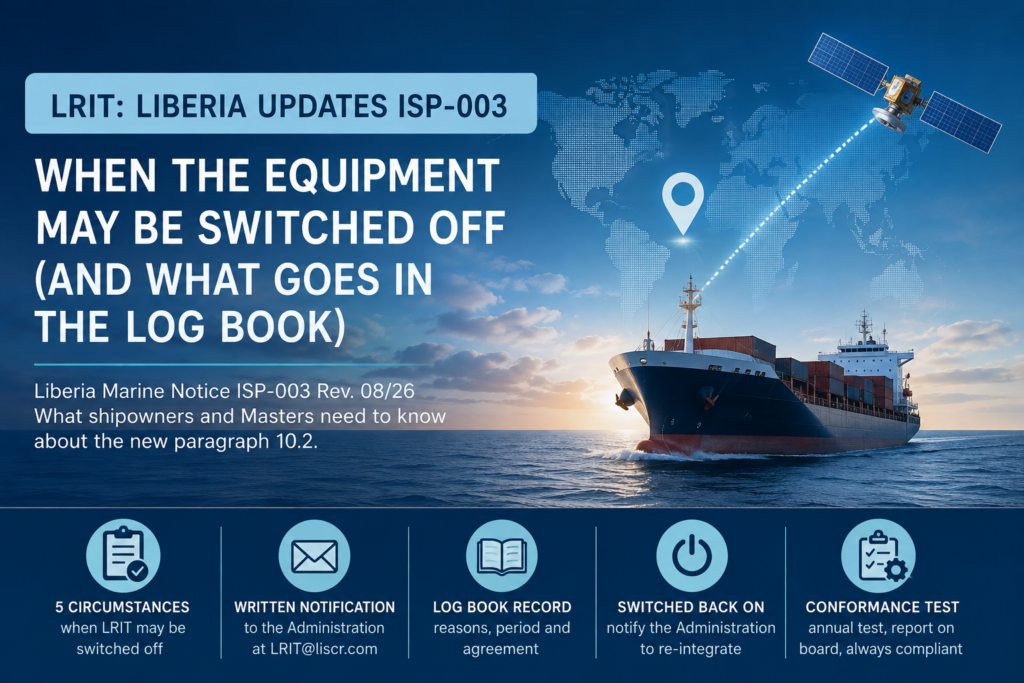
The Master or the Company Security Officer must notify the Administration in writing, at LRIT@liscr.com, of any situation that may warrant switching the equipment off. The revised text identifies five:
- where international agreements, rules or standards provide for the protection of navigational information;
- in exceptional circumstances and for the shortest possible duration, where the Master considers that transmission would compromise the safety or security of the ship;
- where the ship is in dry dock undergoing repairs, modifications or conversion;
- where the ship is laid up for more than seven days;
- where the ship is without electrical power for more than twelve hours.
In each case the notification and the Administration’s subsequent agreement are to be recorded in the ship’s official log book, setting out the reasons for the decision and the period during which the equipment was switched off. Equally important — and this is the step most often overlooked — the Administration must also be advised when the equipment is switched back on, so that the ship can be re-integrated into the Liberian LRIT Data Centre.
Equipment failure is treated separately. In that event the notification extends to the Administration, the Recognised Organisation and, where applicable, the local port State authorities, again with an entry in the official log book; the Master or CSO must also request a dispensation from the Administration in order to operate pending rectification.
The conformance test remains the pressure point
The regime that came fully into force over the past two years is worth restating, because it is where the majority of the non-conformities we encounter during inspections arise.
A conformance test is required upon registration or re-registration under the Liberian flag and, thereafter, annually on or before the anniversary date. Since 1 January 2024 the Conformance Test Report has been issued with a validity not exceeding twelve months from completion of the test. The report must be kept on board with the ship’s documents: FAL.2/Circ.133 of 27 June 2022 added it to the list of documents required to be carried.
A few operational details that make the difference:
the test submitted for registration purposes must be less than one month old;
it must be conducted exclusively through the Authorised Testing ASP’s portal (ondemand.polestarglobal.com);
the process takes approximately 48 hours, is carried out remotely and preferably with the ship at sea, so it needs to be scheduled rather than improvised on the eve of a survey;
where more than one terminal on board is intended for LRIT purposes, each requires its own test and its own CTR, although only one is registered in the Data Centre at any given time;
at annual surveys the attending surveyor will endorse the relevant safety certificate provided the CTR is still valid; where it is valid, no further verification of the equipment is required.
The Notice is candid about the reasoning behind this tightening. Alongside IMO Assembly resolution A.1192(33) on measures against ships concealing their identity, it cites the United States Quint-Seal Compliance Note of 12 December 2023 and the OFAC guidance on the price cap for crude oil and petroleum products of Russian Federation origin. LRIT is no longer purely a safety and security instrument: it has become part of the sanctions compliance architecture.
Maintenance: lessons learned
The Administration devotes a section to the recurring causes of signal loss across Liberian tonnage, and it is a list worth pinning up in the radio room. In the majority of cases — better than three in four — resetting or powering the unit down resolves the problem. Beyond that come the need to re-upload the DNIDs, antennas obscured by cranes, superstructure or shoreside buildings, loose connections or water ingress, changes of equipment, and deactivated ship earth station numbers.
Two practical points. On Inmarsat-C installations, up to four Pole Star DNIDs should be enabled, one for each ocean region; the DNID table can be corrupted or wiped during firmware updates or repairs, so it should be checked after any maintenance to the unit. And when renewing the Radio Station Licence, care must be taken not to deactivate the very ship earth station number associated with the LRIT terminal — a small oversight that produces an immediate non-conformity.
About us
Marine Surveyor Consultant Sagl acts as a Business Development Representative (BDR) for the Liberian Registry. We assist owners and managers with registration and transfer of flag, with the documentary review of statutory compliance on board.
Marine Surveyor Consultant Sagl Via Livio 5, 6830 Chiasso, Switzerland Tel: to be inserted Email: to be inserted Web: to be inserted